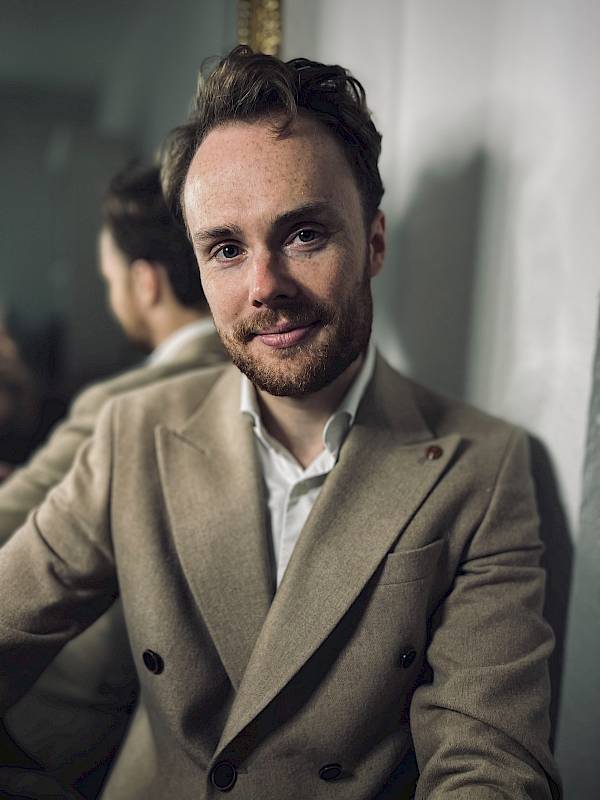
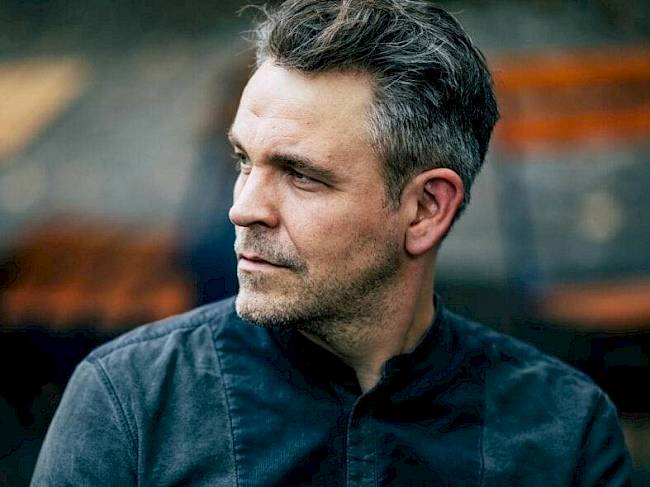
Director Thorleifur Örn Arnarsson in conversation with Dramatic Adviser Jana Beckmann.
In his new production, Director Thorleifur Örn Arnarsson portrays Tannhäuser as a story of homelessness. Lost within his own consciousness, he embarks on an inner journey from self-deception to failure.
What does homelessness mean for Tannhäuser?
Tannhäuser isn’t only homeless in the world, but also within himself. He has lost himself. He is constantly on the run, driven by restlessness and his own inner turmoil. Whenever he is offered a home, he can’t accept because he doesn’t feel at home anywhere. Tannhäuser is caught in a vicious circle of permanent self-deception which he also projects onto the world around him. Maybe that’s the worst kind of homelessness and loneliness. This existential homelessness is the starting point of his journey inside, to himself.
Annie Ernaux writes, “A pilgrim doesn’t search for the path – the path makes him who he is.” Do you see Tannhäuser as a character who has to fail in order to find himself?
TA: Pilgrimage isn’t about arriving. It’s about what one learns about oneself, one’s place in the world and one’s inner voice along the way. Pilgrimage means being ready to experience spiritual transformation, embrace humility and accept one’s mistakes. Tannhäuser isn’t capable of this, which stands in contradiction to his self-image. In our production, he experiences a kind of purgatory and finds himself in an inescapable existential dream on a loop. A dream in which he repeatedly faces the same choices and yet is condemned to repeat the same mistakes – a journey of failed heroism, failed redemption and failed love on endless repeat.
Wagner’s ‘Tannhäuser’ consists musically of breaks and contradictions. In relation to this opera, Theodor W. Adorno popularised the term ‘phantasmagoria’. How is that reflected in this production?
TA: ‘Tannhäuser’ stands in contrast to Wagner’s later works of musical theatre which are much more densely composed. Musical dramaturgy is characterised by its breaks. That led us to imagine a dream logic, to enable every break-laden piece of the puzzle to be observed independently, with sincerity. The whole plot unfolds within Tannhäuser’s head. By means of the logic of a dream, we find ourselves in a room in which the subconscious – which is awakened within the dream, distorts reality and overwrites or directs the action – negotiates according to its own unique set of rules. We see this in, among other things, the multiplicity of his self. As a pilgrim, he wanders the landscape of his inner self. But the truths within the apparitions are fleeting, elusive. What a moment ago was felt to be beautiful can in the next moment become a nightmare. At the end of a dream sequence, Tannhäuser comes to the next place where another test awaits. It’s about the tipping points in our lives. His journey is one of breaks and contradictions and it takes us through a range of emotional circumstances. We’re tracing those breaks.
‘Tannhäuser’ is a journey into the inner self. The set designed by artist Erna Mist depicts the state of Tannhäuser’s soul as a surreal landscape.
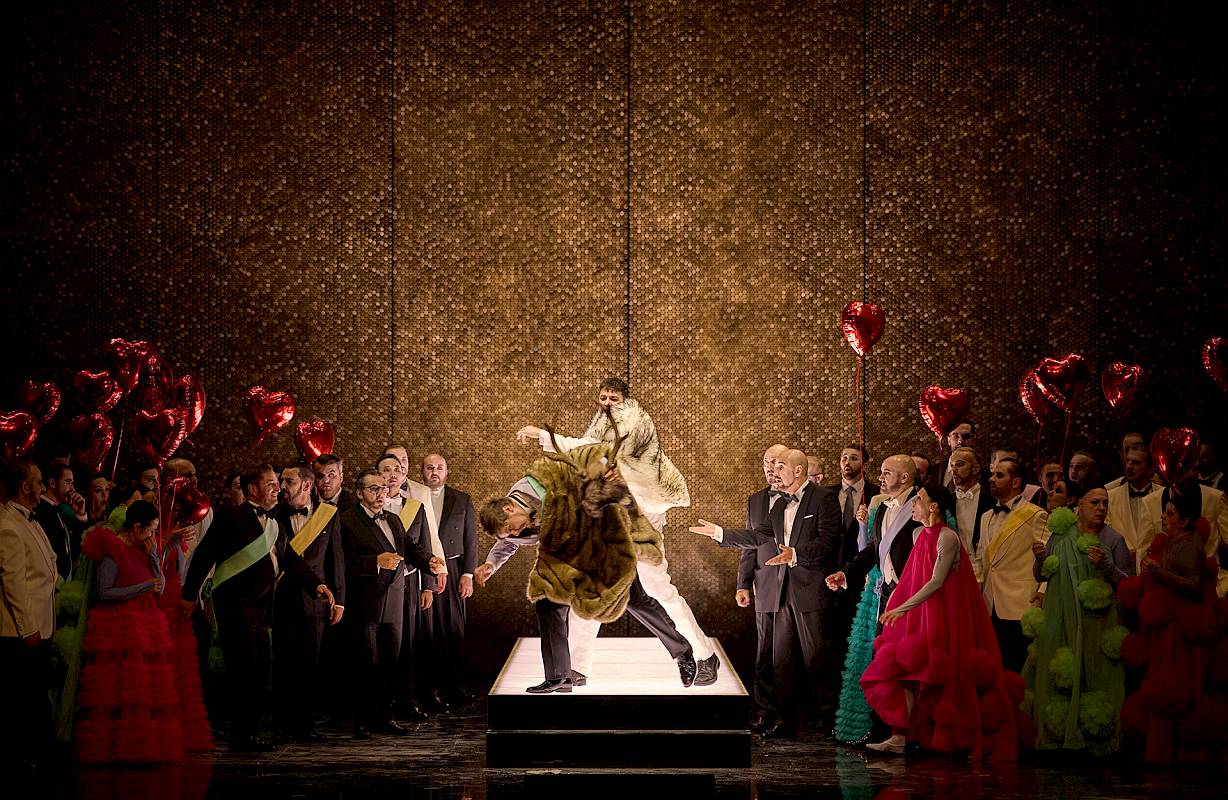
The stage displays a series of inner landscapes – a world inspired by dream logic, in which Tannhäuser’s condition pervades his surroundings. The spatial concept springs from Tannhäuser’s existential, Sisyphus-like suffering. The Venusberg is a landscape of empty glasses on a seemingly never-ending table, while the Wartburg resembles a golden cage whose claustrophobically-heavy walls are gradually closing in. Behind every surface hides a sense of loneliness and alienation. Ultimately, Tannhäuser gets lost inside the mirror maze of his own fragmented self. His relationship to love is equally unstable and because it’s the idea of love which consumes him rather than love itself, we decided to transform Elisabeth into a statue and Venus into an illusion. Following the same dream logic, the pilgrims are simply projections which embody his own subconscious. What we see on stage is, in reality, Tannhäuser’s psychological landscape, his existential architecture and his fluctuating emotional climate.
The world doesn’t offer truth, but rather the choice of what to love. For you, it’s less about the polarity – either Venusberg or Wartburg – but more about how to overcome these two worlds …
TA: There are situations in life where you dream of something and when it actually happens you realise that dream and reality are completely different. When Tannhäuser sees that neither Venus nor Elisabeth give him what he’s searching for, he recognises that he was mistaken, without learning a lesson about himself. He fails because he remains the same man with the same problems and the same character flaws. Venus shows how dangerous and toxic this relationship is. She is the opposite of Elisabeth, who represents another kind of love and another kind of worldview. Seeing the Wartburg and Elisabeth as the principle of conformity and convention, while viewing the free love of the Venusberg as the polar opposite seems to me to be only part of the truth. Beyond that, I want to examine the existential journey of a character on a more personal level. His restless search for fulfilment condemns him to a life devoid of peace. No sooner has a desire been fulfilled, than the next stands waiting; happiness appears ever elusive, the grass is always greener on the other side. In this way, desire itself becomes the catalyst of endless enterprise. It’s therefore not my intention to pit the two worlds against each other. Elisabeth and Venus represent Tannhäuser’s struggle with love and his inability to love, to live and to find his way in the world. It’s all about escapism as a way of life.
What awaits him at the Wartburg?
TA: The party at the Wartburg, to which Tannhäuser is invited, can at first glance be extremely tempting, particularly if one feels lonely. Especially if one grew up there and was expelled. Hope, nostalgia and the possibility of a return. A picture is shown of a neoliberal elite, like champagne socialists, who are enjoying the unbridled luxuries of the bourgeois lifestyle, whilst preaching social justice and progressivity. The Wartburg describes a system that is, at its heart, deeply reactionary and patriarchal. Men are part of a sneering class, whose chief goal is to preserve its privilege. Women are treated as possessions and worshipped – so long as they don’t attempt to exert any kind of authority.
Why is Elisabeth’s death an act of self-determination rather than one of self-abandonment?
TA: Elisabeth doesn’t sacrifice herself for Tannhäuser. She intentionally removes herself from a world in which she has no place, a world which objectifies her and uses her as a projection screen. When she positions herself between Wartburg society and Tannhäuser, she still believes that a person can change. In Tannhäuser she sees a path to freedom. She acts not as a victim, but as somebody who truly believes in transformation – as much in herself as in him. We depict her as a strong woman who is angry and deeply disappointed. She understands the role that has been sketched out for her. She is the prize in the war of the singers. But she doesn’t die because Tannhäuser fails to find redemption. She goes because Tannhäuser betrays the idea he could have espoused. In doing so, he robs her of the opportunity to live differently and more freely. Her death isn’t a sacrifice – it’s an act of self-determination. She leaves a world in which her hope has no future.
To what extent do the inner turmoil, powerlessness and sense of failure experienced by Tannhäuser reflect a current societal phenomenon?
TA: Tannhäuser would rather lose himself in the bliss of ignorance and distraction than concern himself with the serious and complex issues facing society today. He stands between the yearning for a time long gone and the necessity for change. That’s a reflection of what, I think, many people feel today: the inability to achieve true empowerment.